Using Lombok wisely: Questions to consider
Should you use Lombok? If yes, to which extent?
Like any tool, Lombok can be useful or misused. Misuse of it is probably what makes Lombok polarizing.
Usefulness of it depends on factors like project requirements, which Lombok annotations are being used etc.
Questions in this article may help with reflecting on these factors.
Is Lombok a language extension?
Lombok generates and hides potentially repetitive code. Since code generating tools cannot introduce new semantics or paradigms to the language, the design of the project cannot (and shouldn’t) change by using them.
Whether Lombok can be considered a language extension depends on the perspective; it brings visible syntax changes, but the actual capabilities of the language remains the same.
Is the improvement only visual?
Are we introducing a Lombok annotation because it makes the code look tidy, or is the design exactly the way we want as well? After all, we’re still responsible from the hidden code it generates.
Is it better than generating the code using IDE for our particular case?
Sometimes, this compromise works well; @EqualsAndHashCode, can help avoid mistakes when new fields are added to a class, while reducing review time (assuming there is a reason to not use records) or, @Builder can improve readability, especially on inner classes.
Other times, visual simplicity might come at the expense of better design. As shown in the pseudocode example below, visually appealing alternative with @AllArgsConstructor is not better, when it is missing a validation:
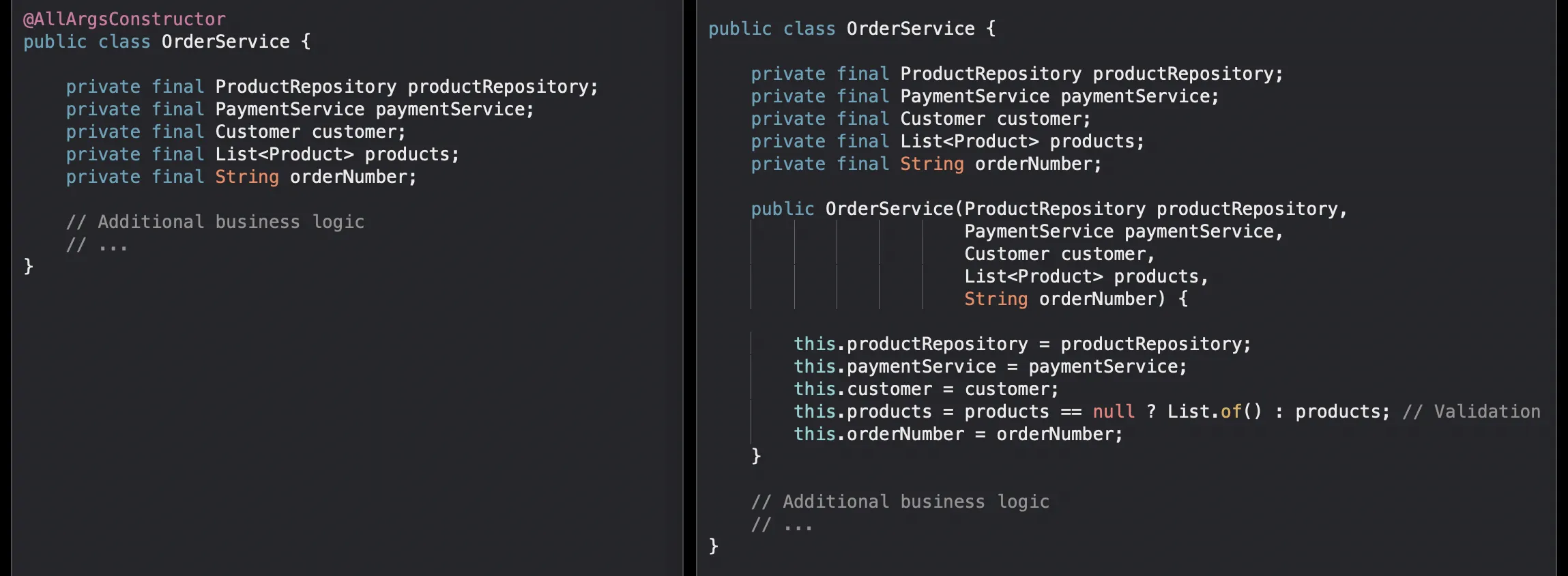
In some cases, visible code can help with reflecting on design decisions, similar to how explaining code to a rubber duck can be helpful - out of sight can lead to out of mind. Though not every annotation needs this.
Are we delaying delivery with unproductive discussions?
Developers may have different experiences and opinions about Lombok.
While some annotations can streamline development, others, like @SneakyThrows need careful consideration, as noted by Lombok documentation. Lombok also includes experimental annotations, which come with their own risk. Some consider extralinguistic behavior of Lombok risky.
Lombok leaves it to the developers to assess the value of each annotation. This can lead to unproductive debates or longer review times. Since the purpose of Lombok is to boost productivity, it is worth reflecting on these discussions.
One solution can be to align the team on a common approach by having guidelines, such as “We are not using experimental features of Lombok”, or encouraging deeper understanding of the tool. Alternatives like AutoValue, Immutables or one of the builder only ones, like jilt can also be considered.
Did we consider compatibility with future Java versions?
Recent versions of Java is improving on integrity. This means that functionalities using the back doors of the platform are either no more allowed or provided with safer alternatives (like sun.misc.Unsafe replaced by VarHandle, ByteBuffer etc).
However, Lombok works by changing the abstract syntax tree (AST), which is not allowed by the Java Language Specification.
Considering that Java development team is not fond of Lombok, it may be wise to expect that later versions of Java to not provide a way for Lombok to continue working.
When the time comes, using delombok may be necessary to remove it. Will we end up with a bloated codebase, if it has been overused? Would we have a better design and long term productivity if we consider safer alternatives early on?
Are multiple code manipulation tools in use?
Sometimes multiple tools and libraries can manipulate the code by changing AST or bytecode.
These can be dependency injection frameworks like Micronout, Quarkus or Dagger, AOP libraries like AspectJ, circuit breakers etc.
Frameworks provide a well-tested bill of materials (BoM), ensuring compatibility between dependencies. Code manipulating libraries outside this set can occasionally lead to subtle issues, especially when multiple tools modify the same class. One time, circuit breakers were silently disabled in our project because of this.
In such cases, it is a good idea to test these tools against potential interference, and use them cautiously, whether it’s Lombok or another code modifying tool.
Did we consider native Java features instead of @Builder, @With, @Value etc.?
By the time of writing this article, native withers for records are in development: JEP-468.
About @Builder: Common use for builders is to make constructors with multiple primitive types safer to use. Named arguments, like in Kotlin, would help with that, but probably won’t come to Java. However, lightweight value classes, (somewhat similar to Kotlin’s inline classes), will promote usage of custom types for the domain (less primitive obsession), allowing safer use of constructors without builders - perhaps a topic for another article.
If these features are present by the time you’re reading, consider using them.
Also, consider using records, instead of @Value and similar annotations, not only to reduce boilerplate, but to take advantage of the new semantics they introduce, which allows for pattern matching, decomposition and more.
Conclusion - Remembering business needs and where Java stands
When choosing development tools and libraries, we must consider the needs of the business, maintenance costs, security implications, and architectural impact. We shouldn’t let the satisfaction of writing concise code or using smart abstractions take precedence over these factors.
This applies to tools like Lombok, as well as the choice of programming languages.
We should also remember that Java was designed for improving industrial application development in teams, by addressing the challenges they were facing with programming languages like C++ at the time. To achieve this, some features found in other languages were intentionally omitted, and some verbosity is introduced. This philosophy continues to guide the platform today.
Not using Lombok won’t improve the design, but misusing or overusing it can hinder productivity and manageability.